

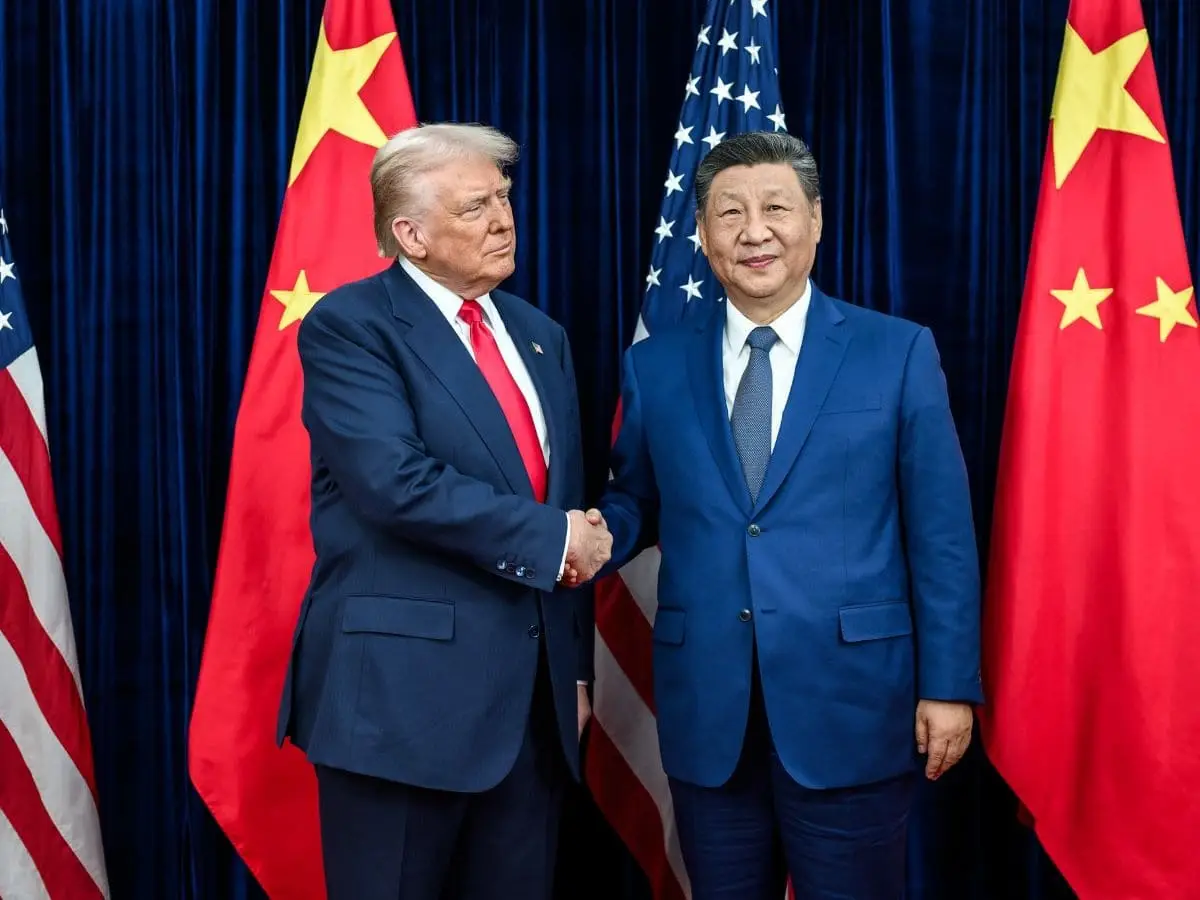
The very recent meeting between Trump and Xi has prompted a series of grotesque comments from the “experts” — the same people who previously rushed to present an impossible “multipolarism” as an established fact, and who now either speak of the advent of a “bipolar world” or claim that the American president has bowed before Beijing.
This is apparently the best our pundits, political scientists, and commentators can offer.
In reality, nothing fundamentally new has happened.
Trump went to negotiate with his main counterpart only after securing a series of temporary advantages, achieved through control over Venezuela and the blocking of the Strait of Hormuz.
But these negotiations produced very little: Beijing merely described the talks as a “new framework” for bilateral relations.
The two governments will continue negotiations — negotiations being the key word — on:
- Chinese purchases of American energy products (oil and gas),
- American agricultural exports,
- control of fentanyl precursors,
- dialogue on artificial intelligence and technological security.
Washington requested an increase in Chinese purchases of American energy, including possible supplies from Alaska, but received no response.
A possible framework of “mutual restraint” regarding Taiwan was discussed, yet no concrete agreement was announced.
It is difficult to understand where commentators found grounds to speak of any historic turning point.
Not even on Taiwan, which the Americans have never formally committed themselves to defend militarily, and which the Chinese intend to annex by 2049 — that is, not necessarily tomorrow.
It is astonishing how commentators continue to chase outdated frameworks and sensationalist scenarios.
Yet it has been clear since the 1990s
that, although American global hegemony exists, it has never amounted to true “unipolarism,” and that China’s rise — suggesting a “bipolar” confrontation between the two powers — must nevertheless take into account global interdependence and the fluidity of relations among the various players, who are at times allies and at times rivals across different arenas.
The Indians call this “multi-alignment.”
In such a world, the United States must simultaneously attract and repel the Chinese while playing all the other actors — the EU, India, Japan, Russia, Turkey, Israel, and the petro-monarchies — against one another, keeping them subordinate to Washington, precisely as prescribed by the “Brzezinski Doctrine.”
Twenty-four years ago, in New World Order Between Imperialism and Empire
I wrote:
“Horror, the disintegration of identities and cultures, and degradation to a bestial level may paradoxically arise more from the failure of globalist leaders than from their success.”
I continued:
“The technological and political superpower of the United States, controlled by Eastern capital, may ultimately produce a standardized system. In such a framework, faceless and civilization-less America would end up entrusting the psychic management of the world to its Eastern partners. The Chinese are perfectly suited to this role. (…) They possess both the mentality and the centuries-old habits necessary to operate an immense global anthill while absorbing all its shocks. For millennia they have been accustomed to living in particularly despotic mass systems, and their mental parameters — whether regarding existence, politics, or economics — though they may appear highly robotic to us, are optimal for a cold, functional, and even maniacally infanticidal form of governance.”
Twenty-four years later, Washington is at once attracted to and intimidated by this prospect, with which it must inevitably reckon.
I had envisioned an alternative
one that largely failed because of the inadequacy of European ruling classes and because of the disastrous choice made by the Russians, who, in seeking to return as an imperial power, ultimately ended up serving both Washington and Beijing — to the detriment of themselves and of us. This alternative consisted in the now-defunct understanding between Europe and the Eurasian line once represented by the Kremlin.
In the same book I also wrote:
“The Europeans, if they succeed in safeguarding it, may in that moment impose the fullness of their culture. The Asians will respond with their millennia-old conception of emptiness as the foundation of all things.”
And again:
“Europe may attempt to play a balancing role in the evolution of the world system, standing up — at the head of a coalition of cultures and nations — to both the United States and China.”
The current moment is particularly favorable
Not in the sense that Europe — whether as a Union or as an alliance of states — can soon become a military power capable of rivaling Beijing and Washington, but in the sense that it can multiply plurilateral agreements that guarantee its political, diplomatic, and even economic centrality while it pursues technological transformation.
The dynamic of rivalry and cooperation between the two superpowers actually works in our favor because, for a certain period of time, both will still need us, and we may even be able to reshuffle the deck.
Even if the “experts” have failed to notice, over the past six years Europe has begun moving on all these fronts and, above all, has established increasingly broad agreements with Japan, India, the Eurasian hinterland, Canada, Singapore, and Africa, while once again turning its attention toward Latin America.
This makes it possible to play the same role that the “non-aligned countries” played during the Cold War: a genuine Third Position from the standpoint of international politics.
Not, of course, in terms of domestic, social, and cultural policy.
There is still enormous work to be done on those fronts.
Clearly, this is the most difficult challenge at the present stage of global capitalist development, but all these dimensions are so interconnected that they are destined to influence one another reciprocally.
A combative Europe
pursuing a Third Way externally must eventually cultivate within itself a political culture consistent with a Third Position — and vice versa.
This is the good news emerging from the Beijing summit.
The only question is whether we are capable of recognizing it.


