

Exactly one thousand four hundred days have passed since the second world army invaded Ukraine.
Today marks the beginning of the forty-seventh month of conflict.
Even the Kremlin’s own official anchorman, Soloviev, recently pointed out that during the Second World War, over the same span of time, Russian tanks had reached Vienna, whereas this time they have not even managed to occupy the entire Donbas.
For him to say this is no small matter: the level of dissatisfaction must be enormous.
Propaganda keeps explaining to us that Russia cannot lose the war
indeed, that it has already won it.
This is due to the intertwining of three distortions.
The first is the astonishing disinformation machine of Lubyanka (the square that houses the intelligence services’ propaganda), which is probably the only genuine Russian world-class excellence.
The second is the shared interest of the Americans, who play heavily on our fear of Moscow to keep us in line, and of European industrial establishments, which need to alarm a complacent public in order to push through what should, in fact, be what every people ought to care most about: its military strength.
The third is the hallucinatory level of superficiality, lack of intelligence, and absence of depth among the vast mass of commentators who trail along behind the prevailing narrative without asking questions and endlessly repeat things they have not even verified. Thus, several Ukrainian villages are reported as being conquered by the Russians every single day, forgetting that the very same news had already been given the day before, two days earlier, or even one, two, three months earlier. Some, in reality, were never conquered at all and still are not: it would be enough to check.
In short, Moscow wins the war on the ground only in the collective imagination, not in reality.
At incredible cost, throughout all of 2025 the front advanced by some fifty kilometers, with no strategic acquisition whatsoever.
If it were only about the war being fought on the ground
the Russian or Ukrainian victory would be decided by which of the two machines collapses first. But there is not only the territorial conflict: there is the entire set of knock-on and collateral effects, and if the war is not going well at all for the Russians, the rest is an outright disaster.
Russian military prestige has been mocked
Two strategic defeats already in 2022 and 2023 (Kyiv and the Battle of Odessa) made the Russians cut the same figure Italians did in Greece in 1941—and we know how much that cost us in terms of prestige and authority.
The Russian fleet has been completely neutralized, suffering serious and repeated losses in the Black Sea.
Even if Moscow were to manage—and I stress if—to conquer, or be handed, the Donbas, what kind of victory would that be? Taking into account the immense human losses, Putin’s victory would become the updated synonym of a Pyrrhic victory.
Meanwhile
Russia has lost—to Turkish/American advantage—all influence in the area between Armenia and Azerbaijan, where, after the signing of the TRIPP this summer, the geostrategic linkage with Iran also collapsed. Since then, Tehran has done nothing but condemn the Kremlin.
In the “Eurasian” neighborhood everything is now done in dollars; Chinese penetration is massive, while geo-economic relations with Europe have multiplied and Moscow’s presence is evaporating.
Eastern Russia itself is now in the hands of Chinese immigration, to the point that in Beijing some believe it could be detached from the rest if Russia were to collapse, while Moscow itself is increasingly becoming the property of Chinese and South Korean capital.
Things are no better in Africa
Although Russia has managed to gain a foothold in the Sahel at Europe’s expense—and did so with the active and brazen help of the Americans, who hosted their troops at their own military bases—wherever it has set foot, the territory controlled by jihadist rebels has rapidly tripled in size.
The attempt to pose as the champion of the African cause in the summer of 2023 quickly evaporated: after gathering more than forty countries at the first conference it convened, a year later only about a dozen remained.
Even worse was the outcome with the Arabs. A few months ago Moscow tried to replicate with them what it had done with Africa: it obtained the diplomatic presence of a representative of the Arab League and, as government representatives, only that ofal-Jolani—the very man who overthrew Assad, who had been defended by the Russians themselves.
And the Iranians seized the opportunity to make Russia’s betrayal in Syria known to everyone.
Nor is the situation any better on the so-called Global South front
The latest SCO meeting saw China playing the lion’s share and India tentatively emerging, while Putin was treated as a subordinate and even had to endure the affront of being told by Xi that “Russia cannot be allowed to lose the war.” Which means that for Beijing not only is this a concrete possibility, but that, to avoid it, Moscow cannot succeed on its own.
Contrary to what propaganda says, sanctions have hurt Russia
It is the testimony of those who work there—that is, people who are rather pro-Russian—that daily recount the hallucinatory conditions of soaring prices and shortages of goods.
Moscow, with its back to the wall, is dumping its hydrocarbons to China and India at bargain prices, just as it is giving up its assets.
Lukoil and Gazprom have already opened up to sales.
A few days ago the U.S. Congress issued a series of measures
regarding American troops in Europe, sanctions on Russia, and arms supplies to Ukraine that were not exactly what Moscow had hoped for—Moscow now reduced to continually begging for American support and Washington’s protection. The American decisions do confirm, however, that it suits them for Russia to continue the war—precisely, to continue it—whereas the Kremlin had deluded itself that they would hand it the victory it failed to achieve and which, had it played its cards better, it would probably have been gifted by the end of last November. Now delivering that victory has become complicated.
Putin is left with the hope that Ukraine will collapse before Russia does
something that would have to occur through the massive use of cheap drones. But there is no certainty that these will break Ukrainian morale, which has proven to be very different from how Russians, Russophiles, and the faint-hearted have always portrayed it. And if that does not happen, what will be left for Russia to save what can be saved—that is, what remains of its face?
Can the formidable media machine suffice? I have my doubts. Especially if even Soloviev…
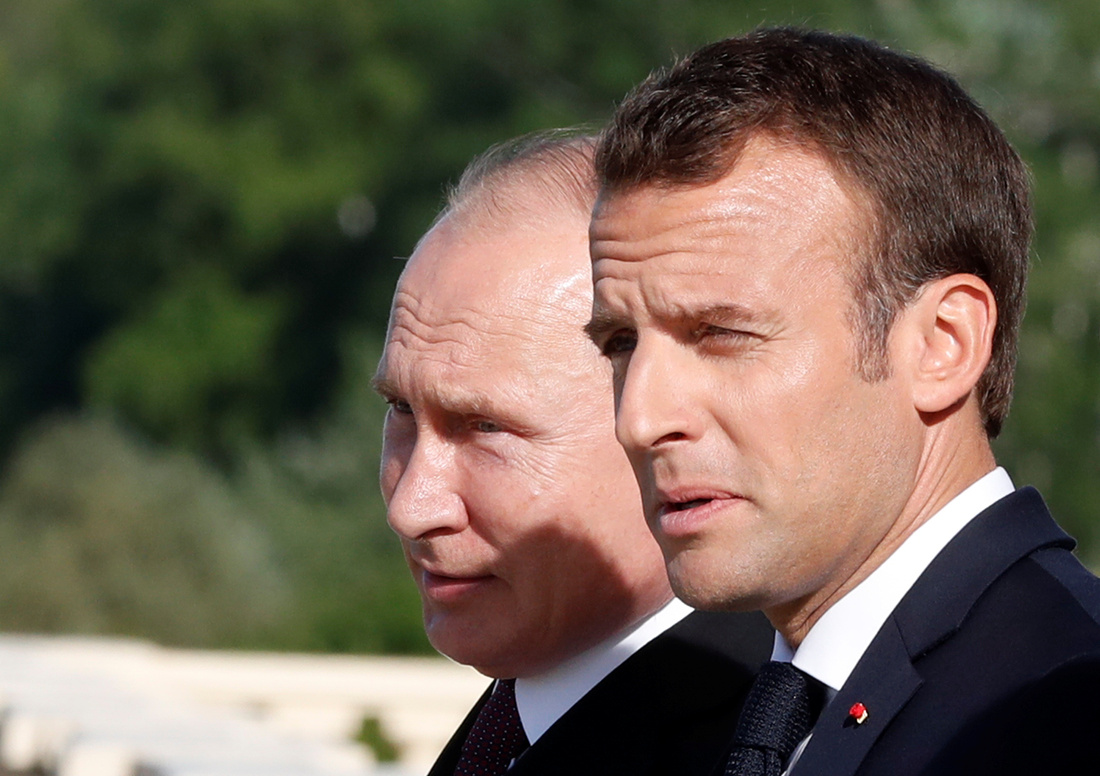
And here is Putin suddenly no longer ruling out the possibility of meeting Macron
spectacularly contradicting himself. The impression is that he is floundering and desperately seeking a way out.
Who knows whether, among the many high-profile deaths unfolding around the Kremlin, there is not a fierce struggle between clans.
Who knows whether the warnings of the Valdai Institute (which stands to Russia somewhat as the CFR does to the USA)—according to which it is urgent to mend ties with Europe and loosen the Chinese garrote—are not becoming too pressing.
Putin is more of an all-or-nothing character, but the times he has broken things and it has gone badly—really badly—are starting to be too many. And if the Russian godfather fails—by whatever means remain unknown—to obtain at least the entire Donbas immediately and to reopen to the West as soon as possible, he might be struck by one of those “illnesses” that were customary in that Soviet Union which he and Lavrov like so much.


