

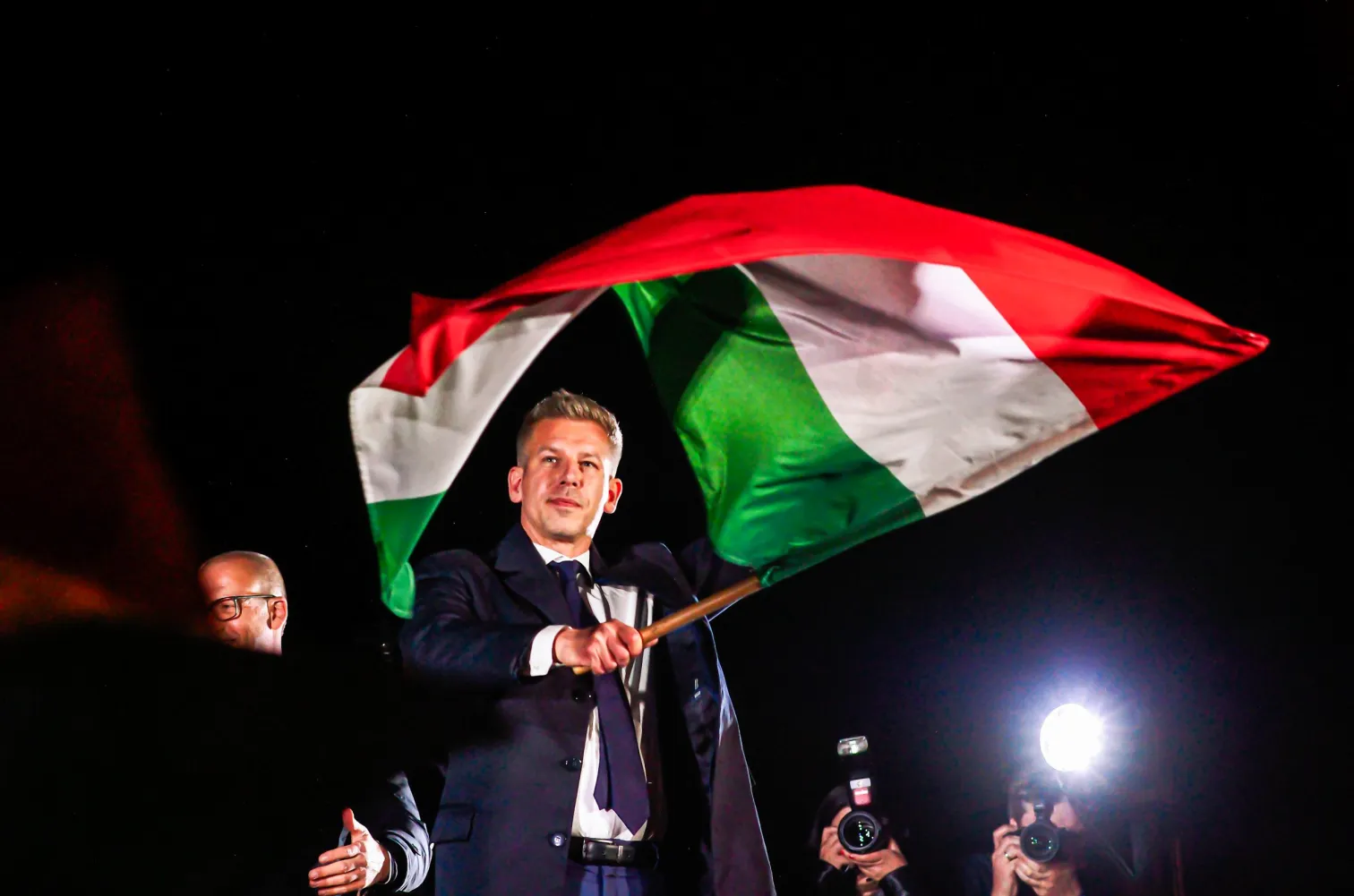
I had written it well before the elections of Sunday, April 12.
I argued that Orbán’s defeat would not be a tragedy; in fact, it represents an opportunity.
Let’s try to understand it better.
We cannot know whether Magyar will be up to the task, nor how strong his backbone is.
Not knowing him, we can postpone judgment until we see his actions.
For now, let’s stick to the winner’s program
t appears far more interesting than that of the defeated.
Doubling funds for birth rates, restrictions on immigration policy, refusal—except in exceptional and justifiable cases—to employ non-European labor.
Then: a party of the Hungarians, as a people and a homeland, beyond right and left. (Does that remind you of anything?) A fight against corruption and the mafia-like system that has installed oligarchs in liberal-Soviet autocracies, there as in Russia.
A central positioning of Budapest between East and West, and a full embrace of European identity without any deference to Brussels.
If they are roses, they will bloom—but they are still roses.
Now let’s explain the victory
of this forty-five-year-old prime minister who challenged and crushed Orbán on the patriotic front.
Magyar emphasized Orbán’s subservience to foreigners—particularly the Russians—and the rampant corruption in a country run by three oligarchic families.
The message resonated strongly: Tisza, the challenger’s party, won more than two-thirds of the seats and achieved a lead of about sixteen points over Orbán’s party, which secured less than half the number of representatives compared to the winner. Third and last in parliament is the ethno-nationalist Our Homeland Movement which, with around 6%, gains a handful of deputies.
Why did Magyar crush Orbán?
Because he captured the popular feeling of indignation toward the government’s servility to Moscow’s imperialism and the resulting offense to national memory and sentiment.
At every rally and march, people continuously repeated the anti-Russian slogans of 1956.
Why had Orbán held on until then?
Essentially for two reasons.
First, the previous elections took place shortly after the Russian invasion of Ukraine, when the leader’s position could still appear balanced and pragmatic. Over time, however, Orbán increasingly came to be seen as a satrap of Moscow, something like a Lukashenko.
Moreover, this time he was not challenged by a globalist, woke, or LGBT front, but by a patriotic one; believing he could hold on was, at the very least, naive.
Nor did the constant foreign interference in the electoral campaign help the outgoing prime minister. Moscow’s support could only be the kiss of death.
But there was more: in the final stretch of the campaign, he was backed by U.S. Vice President Vance and Netanyahu’s nephew, at a time when the Middle Eastern slaughter was in full swing.
A lack of analytical capacity must be noted
I’m referring to all those who—on one side or the other—observed the electoral battle and the real positioning of the actors involved.
Why is Orbán so submissive to Russians, Americans, Israelis, and Chinese alike?
For anyone with even a minimal knowledge of history and of the operational methods of the actors involved, it should not have been difficult to understand that, with the collapse of the USSR, the Soviet apparatus moved very effectively on the only terrain where it excels—deception and subversion—and that it secured the collaboration of various Stay Behind networks.
Everything had to change so that nothing would change.
Thus, politicians placed in the center-left were supported, including Schröder, who later went from German chancellor to a Gazprom official.
But—reviving a strategy already outlined in 1957—the Soviet apparatus also infiltrated emerging populism, placing cadres trained in communism and equipped with resources at the head of improvised parties, with the task of subordinating them.
Orbán, like Merkel, paralyzed national energy autonomy and subordinated their nations to Moscow, even to the point of openly spitting on the history of their own peoples.
At the same time—this was in 1991—Russian services sent various “dissidents” to make contact with the far right. Among them, Dugin and Limonov gained prominence, who at least, unlike others, have the merit of being agents of their own country rather than servants of another.
Special mention goes to the AfD, which—after allowing German national-revolutionaries to act as a cover for its supposed far-right image—merged the Frankfurt School with Stasi apparatuses, becoming the quintessence of corruption. A Five Star Movement to the nth degree.
That shameless convergence of all our enemies
If the Kremlin, the White House, and the Knesset all revealed themselves together in a desperate attempt to save their puppet in Budapest, it should be clear—and indeed THEY say it openly, it is we who refuse to hear—that they are enemies of Europe, and that “sovereignism,” as we call it, is one of the main tools against the sovereignty of our peoples.
This should not be difficult to understand. The problem is that many refuse to understand.
By now, in certain circles, people “reason” on the basis of fetishes, slogans packaged by others, ignorance, superficiality, and supposed conspiracies that, from time to time, blame the usual Soros figures for the bitter defeats of the servants of their masters.
Regardless of what may happen tomorrow in Hungary, the popular rejection of Orbán—massive both in the streets and at the ballot box—is a clear and indisputable proof of the shared sentiment. Feelings can be ridden, interpreted, distorted—but they are not created out of nothing.
It is no coincidence that our enemies—both East and West—understood in time and swiftly occupied the ground of that populism they saw coming on the horizon and had certainly not hoped for.
They tried—successfully—to use it against itself.
Now, however, this “sovereignism” is fractured
and it is above all leaders in their forties and fifties—those formed in the field rather than in the cadre schools of communists and Stay Behind (which ultimately are the same thing)—who are breaking it apart in a European direction, bringing a breath of fresh air into a political environment that has been carved up from the beginning by agents and servants of our masters. These masters are now losing ground and pieces, and that is the best news of all.
Neither Red Front nor Reaction!
Nor that Frankenstein which combines both in various forms, including the red-brown lie and the mistake of taking agents of foreign powers for sovereign leaders.


