

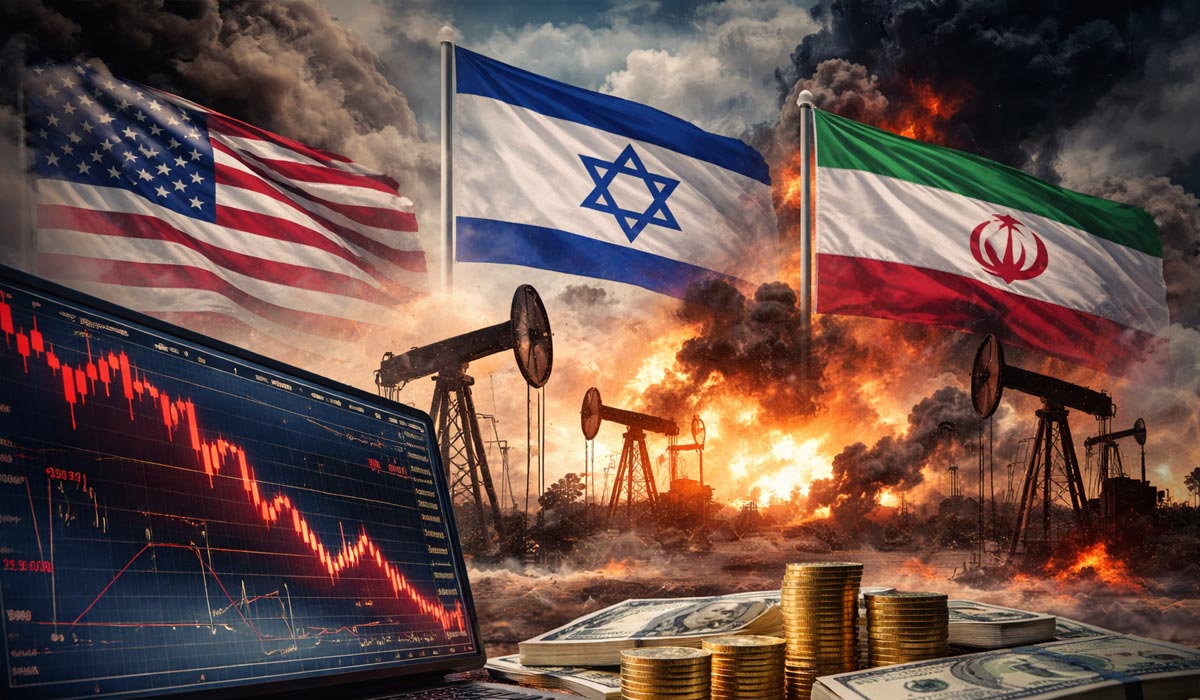
The Middle Eastern derby, with the elimination of various local protagonists, provokes reactions that are rarely well-focused.
The violation of international law by the USA and Israel?
Nothing new — and certainly nothing exclusive. Ever since this body of law has existed, it has been respected only by those who are not fighting. Let’s not kid ourselves.
The atrocities of indiscriminate bombings, even on schools?
We ourselves know very well that the Anglo-Americans invented them, along with napalm bombings, phosphorus bombings, and nuclear strikes.
Others, however, have copied them perfectly. Russia in Ukraine — and before that in Chechnya. Iran no better in Iraq. Not to mention the bombings of civilians and the destruction of rebel Syrian cities by Russians and Iranians. And I am not even considering here the private militias of the various Caliphates.
So we should simply acknowledge the arrogance of the strongest power without descending into discriminatory and hypocritical moralizing that ought not to characterize us or insult our intelligence.
Then there is the political reading, still to be made, since we must wait for the outcome of what, in Tehran, looks very much like a coordinated act — from outside and from within — as in Venezuela.
This is not the fairy tale of the West versus the Global South.
First of all, Israel is not in the West, nor is it Western; rather, it is a subject of syncretic culture, composed of western communities, religious fundamentalists exactly like Islamic ones, and a strong component of eastern Jews with an Asian mindset similar to that of Russians.
Above all, it is not Western because in this derby — alongside the Israeli-Americans and against the Iranians — there are Sunni and Wahhabi countries, governments, and movements that are in conflict with Tehran in various arenas, foremost Yemen.
In fact, apart from the economic effects, we are external to this conflict.
Except with regard to the Red Sea, where the Houthis, maneuvered by Tehran, have so far harmed Europeans to the indirect advantage of the Americans.
Let us understand the reasons
that for some time now have set Tehran against those who armed Iran against Iraq — namely the USA and Israel — which for decades (as has been publicly known since the Iran-Contra affair) supported it and even armed it in its systematic actions against social-national regimes, the pan-Arab cause, Palestinian nationalism, and in launching an internationalist imperialism that has caused ethno-religious wars among Muslims, effectively paving the way for the utopian scenario of Greater Israel from the Jordan to the Euphrates.
Why, suddenly, did the best agent of the Israeli cause in the region find itself in real tension with Washington and Tel Aviv, and no longer merely in their fox-and-cat comedy?
We have long argued that the discovery of offshore gas and the transformation — at least since 2020 — of the Jewish state into a major Israeli-Arab energy hub has altered regional relations and, through a series of cooperations such as the Abraham Accords or the MEAD air-defense system, has created a new system of alliances. Now, unlike yesterday, Israel finds Sunni bourgeoisies and emirates more useful than Shiite imams.
Moreover, the Israeli-American pair is also playing its own cards in acquiring hegemonic stakes within the new coalition. Washington must demonstrate that it remains indispensable within it, to prevent Arab-Israeli third-worldism from turning in the future into a power to be dealt with on equal terms.
Thus, exploiting the internal clashes among Iran’s politico-religious mafias, the Americans, the Israelis, and the Wahhabis cooperate with one another — but they also compete for prestige during the action. Somewhat as happened among the Allies in the Second World War.
Speaking of world war
In January 1942 someone said that if it were lost, the world would fall into the hands of Organized Crime — and that is what happened, even technically speaking, considering the role assumed by mafias and clans on every side of the hemisphere.
A recurring mistake is to attribute this condition exclusively to the hegemonic power — or powers — when it is instead a common, shared, and cross-cutting condition that needs to be overturned.
The various criminal organizations of power and counter-power are constantly both accomplices and rivals, and there is no essential opposition among them.
Thus, if the Iranian religious mafia — which objectively and for a very long time served the interests of more powerful clans, such as the American and Israeli ones — now finds itself taking blows and returning them, or pretending to do so, it has no standing to present itself as a victim or as an alternative.
We are witnessing a repetition of clashes between Palermo and Corleone factions, or a local unraveling of Yalta, as happened from 1979 onward when the Russian servants of the Americans lost their support after overstepping with the attempted imposition of interference in Afghanistan.
Iran, on the level of international politics, has served mafia-like causes
and has sabotaged or destroyed those that had an ideal value and interesting potential. It did so to the detriment of the PLO; it did so against governments that supported Palestinian patriots, such as Iraq and Libya.
It acted against every national dimension, beginning with the attempt to spark a civil war in Iraq among religious communities.
Now it is being scaled back, and there is no more reason to complain than there would be if criminals in robes arrested a scoundrel with whom they had always shared their spoils.
Out of personal taste, I would even venture a reflection that I rather like:
One by one, starting with the judge who had him hanged, passing through the Syrians who cooperated with the enemy coalition, and ending with the Iranians, Saddam went after them all.
If we really insist on taking sides in a vomit-inducing derby
we should at least avoid losing our heads.
I can understand that, by reasoning through exclusion (which is what those without clear ideas or a concrete program of action are forced to do), one might end up cheering mainly against one of the two contenders, whoever that may be.
Even so, it is essential to understand that this is not a conflict between a generic West and some supposed Global South, since it is a southern and eastern derby directly involving the world’s hegemonic power and only indirectly China and the only other global power, Europe.
Whether one chooses to root for or against “the West,” one is at the very least in the wrong match.
For those who believe this is a war against Islam
or against Islamist threats, I would point out that many of the players supporting the anti-Iranian action are Muslims and even jihadists. If some think that Saudi Arabia, Qatar, or the United Arab Emirates are fighting Sharia law, they are gravely mistaken.
For those who prefer the pigsty of obscurantist tyrannies to Western decadence, I would only recommend the address of a good psychiatrist.
A psychiatrist is very much needed! Lately, out of infantilism or sheer muddle-headedness, some have even begun praising North Korea or glorifying a regime—the Iranian one—that imprisons women who do not wear the veil or who wear tight trousers, and that hangs dissidents.
It resembles a communist regime with the added burden of theocratic obscurantism which—absurdly enough—some have confused with Tradition, when it is precisely its absolute negation, at least in the forms assumed by Indo-European peoples.
We are witnessing a re-edition of Guareschi’s “three-nostriled” mindset: those who cannot make money want to impoverish those who produce; those who cannot win their own freedoms take pleasure in seeing freedom denied to other peoples.
That the Iranian regime, besides having always played a politically subversive role, is aberrant can only be denied with tons of bad faith or while thrashing about in a straitjacket.
And if, swept up in this other derby of the century, some cheer for the imams because they repress and hang gay people, beyond the absurdity of that in itself, it should be clarified that those repressive laws were the first enacted by Khomeini in 1979, with penalties varying according to degree of kinship and centimeters of penetration.
Which means that—if that were to be taken as the indicator of decadence—it would point to a widespread and mass phenomenon, making it a society that cannot be held up as an example even from that obsessive standpoint.
Does someone prefer these over those? De gustibus—indeed, de disgustibus.
And the same applies in reverse.
The point is not to determine which side is the lesser evil
nor to decide how they should live in their own lands, but to understand what matters to us as European peoples.
And, in the Middle Eastern and Red Sea scenario, that can only mean maintaining multilateral agreements with everyone without becoming in the slightest entangled in their mess.
It appears that no European government is backing one side or the other, but rather seeking mediation. Even the United Kingdom has rightly denied its bases to the Americans; Spain did the same; Italy’s moderating position—which has all the credentials to act in that role in the region—is currently explicit.
And if one insists on not reasoning in terms of politics and civilization and, once Sanremo is over, simply cannot resist taking sides, then let everyone root for whomever they like.
Personally, I recommend popcorn.


